

Germany just completed its federal elections with some unsurprising and surprising results, many narratives are flowing out of it, with many a commentator framing it as a “crushing” defeat for AfD, but is that really what happened?
First, a brief overview of the German electoral system:
Germany uses a system of proportional representation. The country is divided into 299 electoral constituencies delineated based on population, with safeguards against partisan gerrymandering should the need to re-delineate them arise. 299 additional seats are granted proportionally, for a baseline of 598 seats. Overhang and leveling mandates can increase the total beyond the baseline, but more on that shortly.
Ballots are split into two votes: the first list candidates running at the municipal level along with their party affiliation, and the second, which is more broadly for parties.
Parties receive a share of the 598 baseline seats based on election performance. To be represented in the Bundestag, parties must receive at least 5% of the vote or win at least 3 constituencies outright (via the first vote).
If a candidate wins a constituency outright (1st vote), it is subtracted from the number of seats it would receive from the proportional vote (2nd vote). Let’s say, Candidate A wins their municipality outright, and their party is eligible to receive 100 seats from the second vote. This win is subtracted from the 100, and the party now has 99 seats to fill, chosen from a ranked list of candidates.
Usually, parties win more seats from the second vote than they do from the first, but in the evwen that a party wins more seats via the direct vote, the surplus received the aforementioned overhang mandates, and other parties proportionally receive extra seats (leveling seats) beyond the baseline 598 to preserve the balance of power. These extra seats historically, can inflate the Bundestag, however, since the 2021 Bundestag forming with 730 seats, this has been capped at a maximum 630 seats (+32 leveling seats) since 2023, meaning that from the 2025 elections onwards, 316 seats (combined or otherwise) are needed to form government.
So, what are the implications?
The system allows for a measure of separation between candidate and party, voters can cast their ballot for the candidate they deem best to represent their constituency, as well as the party they deem best fit to represent their interests at the state level. This allows for everyone to vote along their interests, and while the system acknowledges that a single party has the authority to rule alone, should it receive a majority on its own, it also incentivises party fragmentation, as any minor party can end up holding the balance of power in a coalition. Since 1867, there has been only one instance of a party winning an outright majority in a contested election (thus excluding 1933-45 and the former DDR), Konrad Adenauer’s CDU/CSU in 1957, with 50.3% of the vote. The last party to come close was Angela Merkel’s CDU/CSU at the peak of its power in 2013, falling 5 seats short of a majority (311 out of the 316 seats needed).
The system is tilted against single-party rule, where coalitions are the norm, and there are no restrictions on what coalition can form, for instance, a ruling coalition is not obligated to include the party with the most seats if the other parties can form a coalition that meets the required majority. This incentivizes cooperation and compromise and disincentivizes diverging too far from the others in terms of policy platform. Using the example of 2013, the opposition could have formed a coalition government despite CDU’s 311 seats, but all it would take to thwart that plan is a party with 5 or more seats going the other way.
So what’s all this mean for AfD?
Where AfD is concerned, the party’s platform diverges far enough from the others that it is difficult for it to find a willing coalition partner, the party also carries a certain stigma (far right, extremists, Nazis, etc) that other parties, even on the right, are reluctant to enter a coalition agreement with it.
It finds itself in a situation similar to Georgian Dream, in the Republic of Georgia, where because it diverges so wildly from the other parties, it cannot form government without winning a majority mandate outright, but that has, again, only happened once.
Onto the results.
While the overall election map suggests that AfD is contained within the former DDR (east Germany) where its powerbase is, this is not entirely accurate, or at least, this assessment doesn’t tell the whole story.
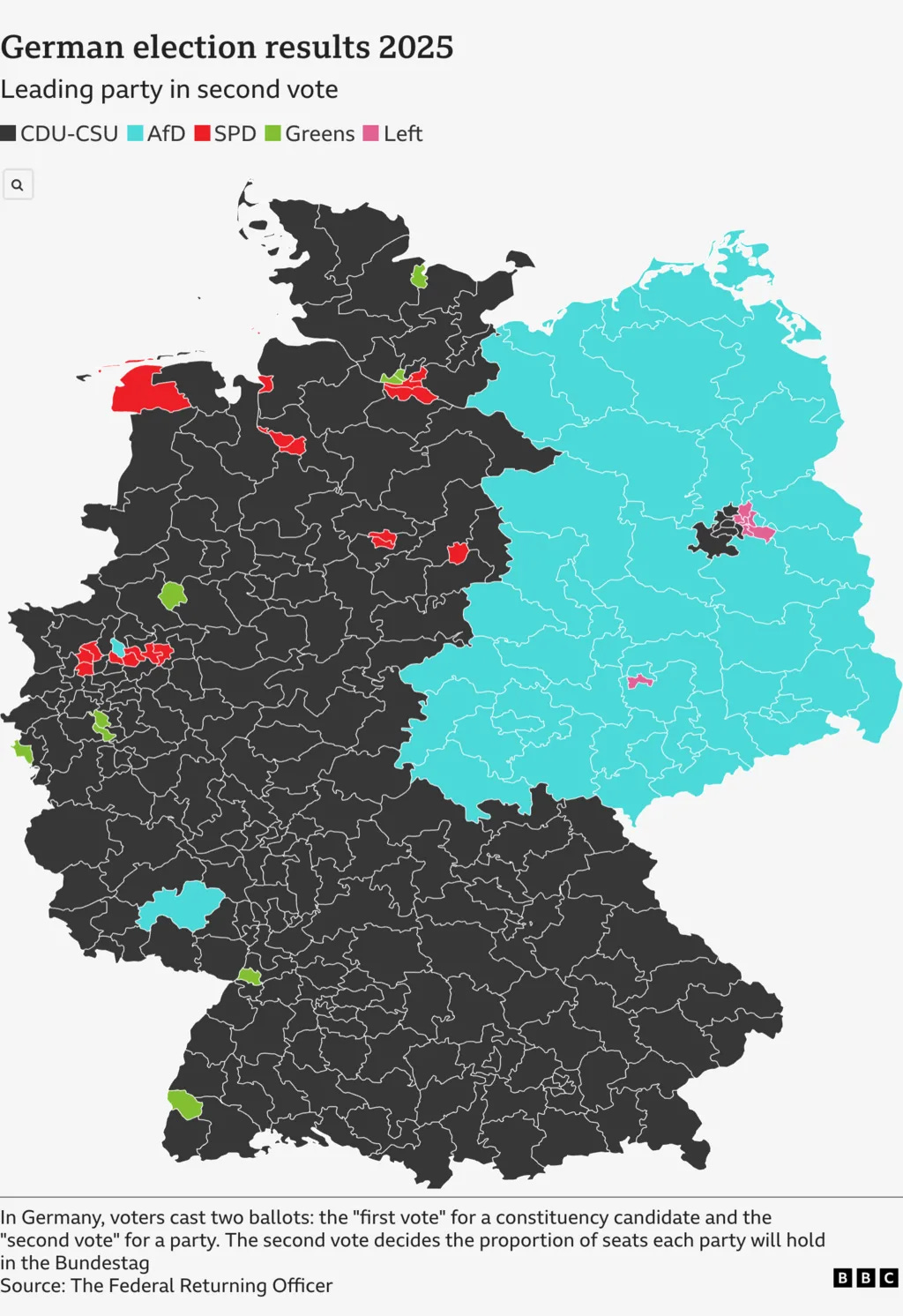
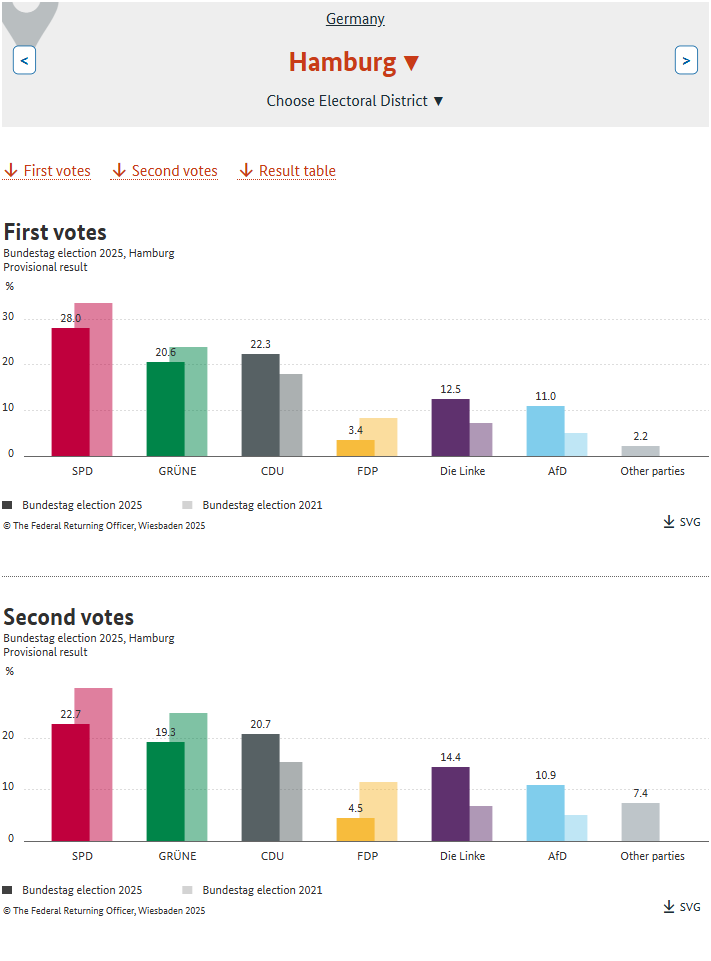
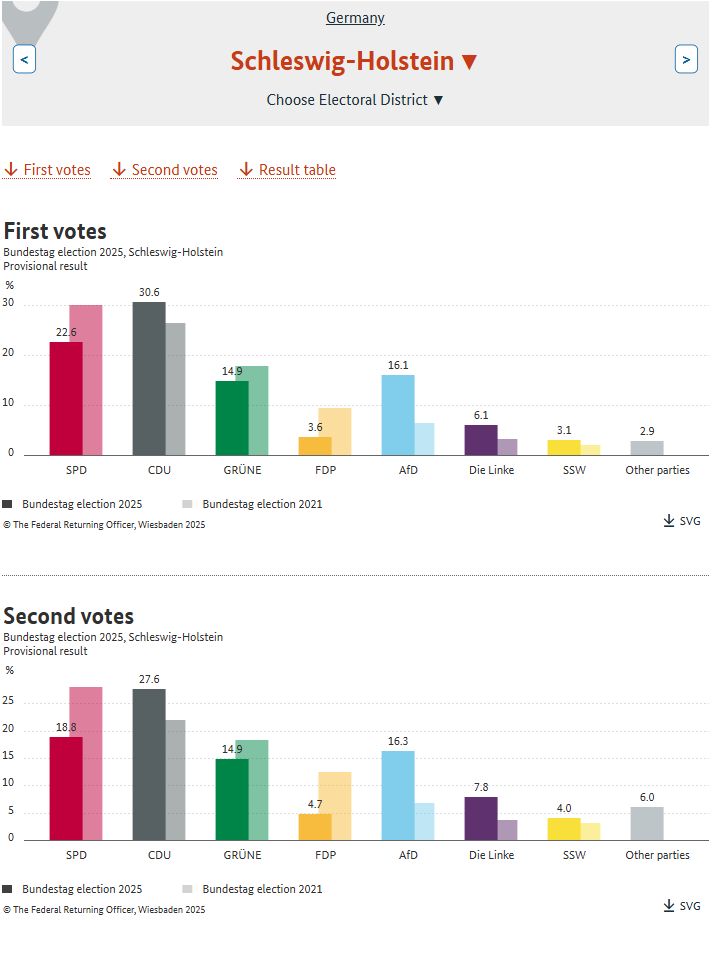
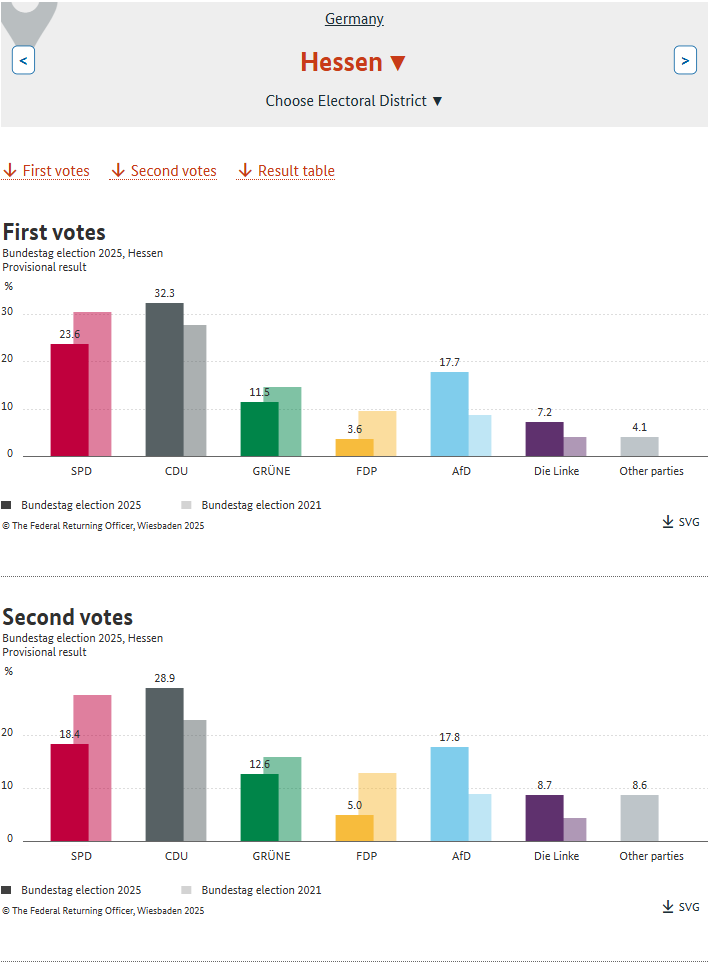
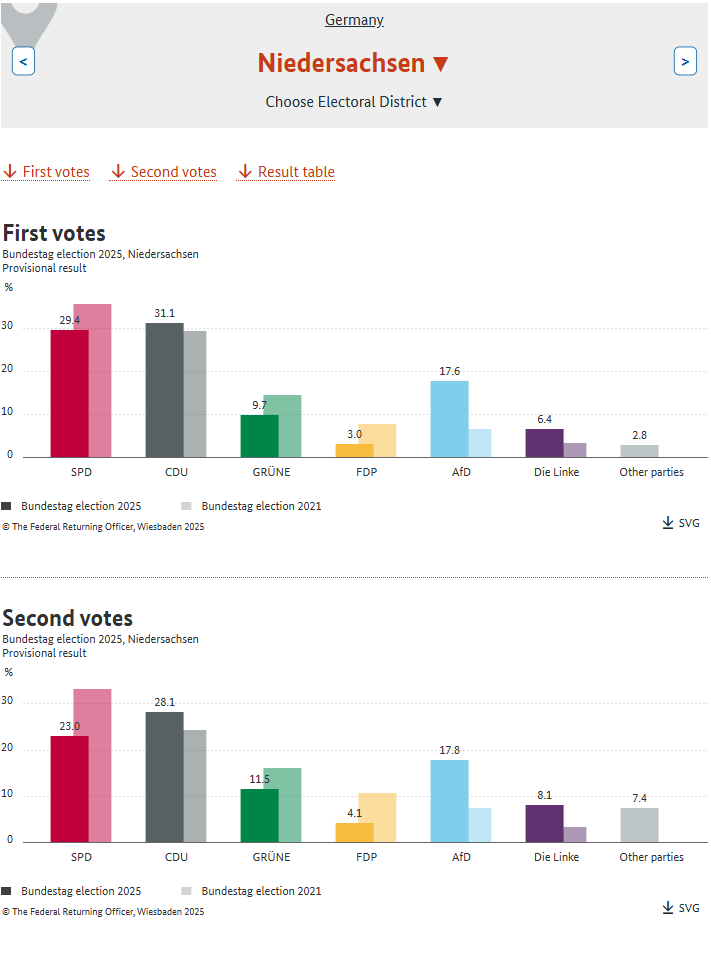
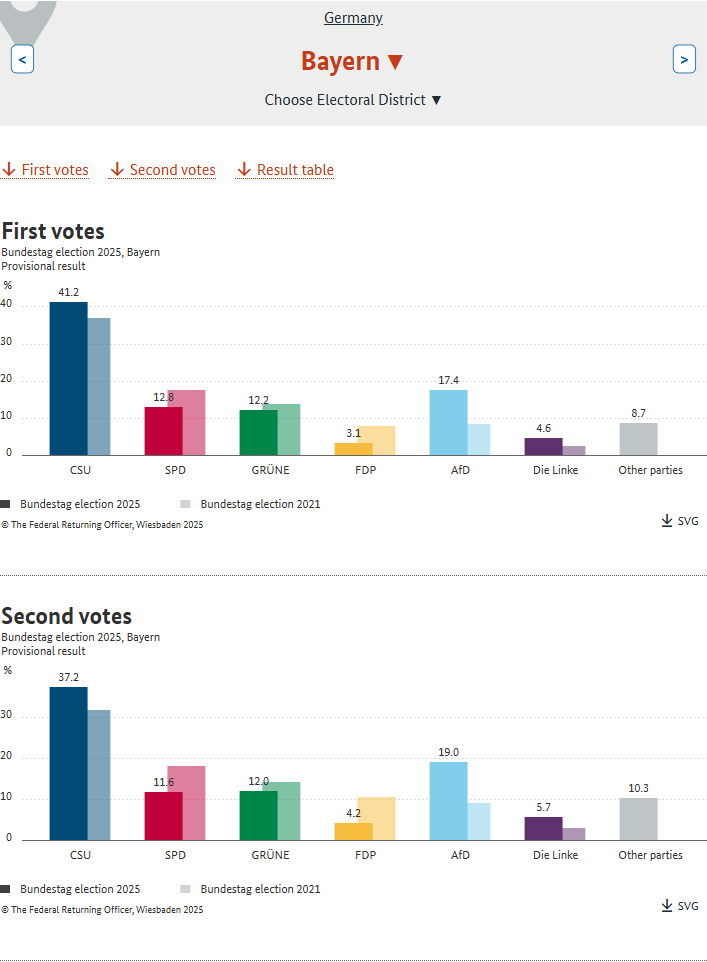
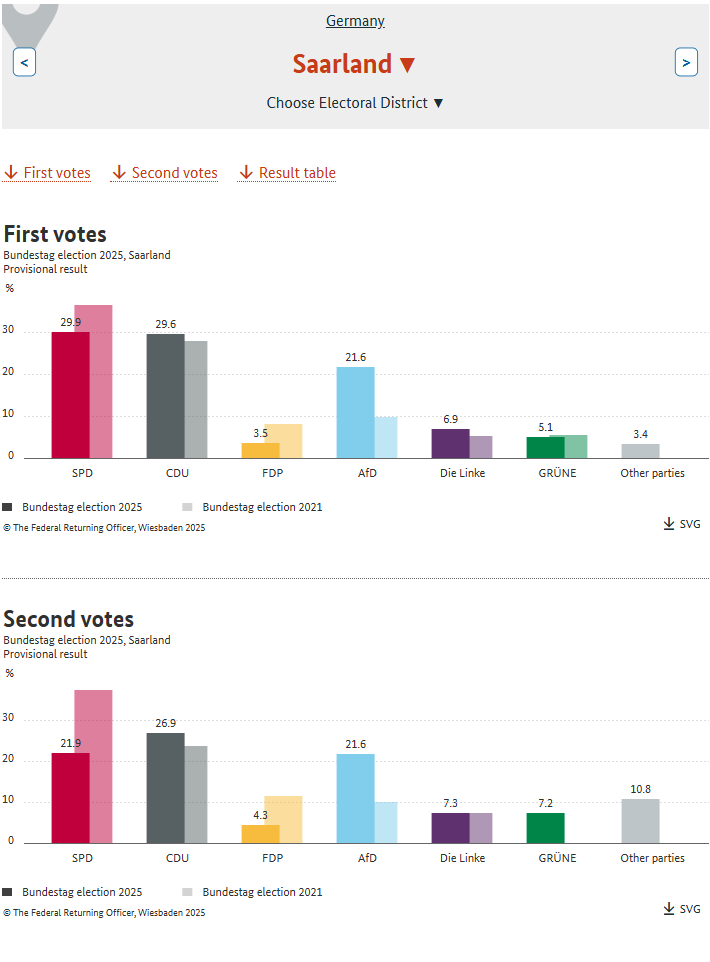
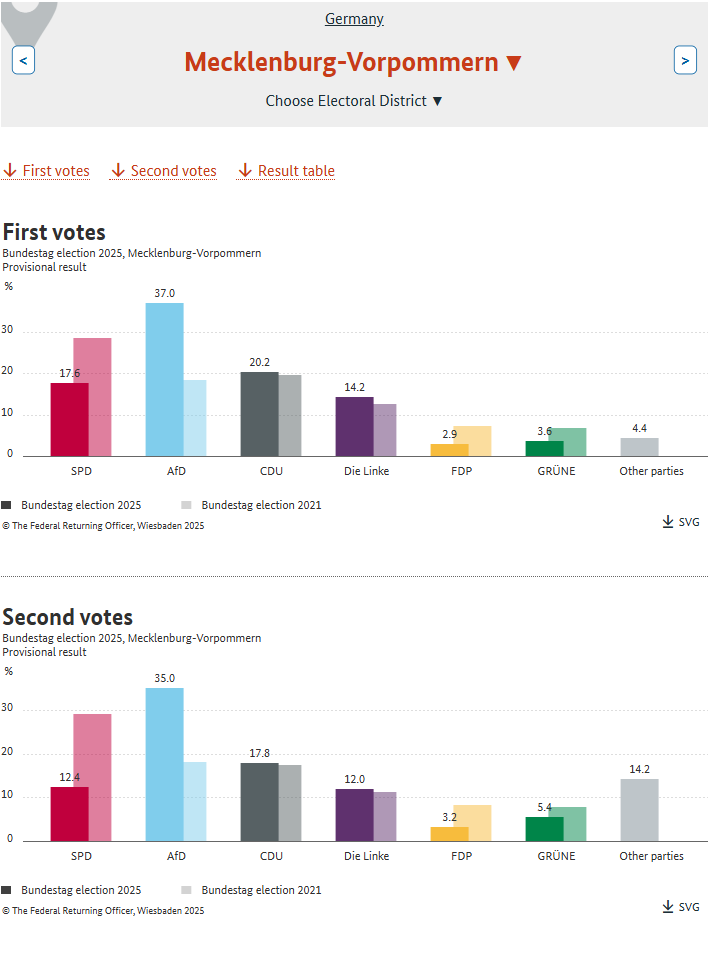
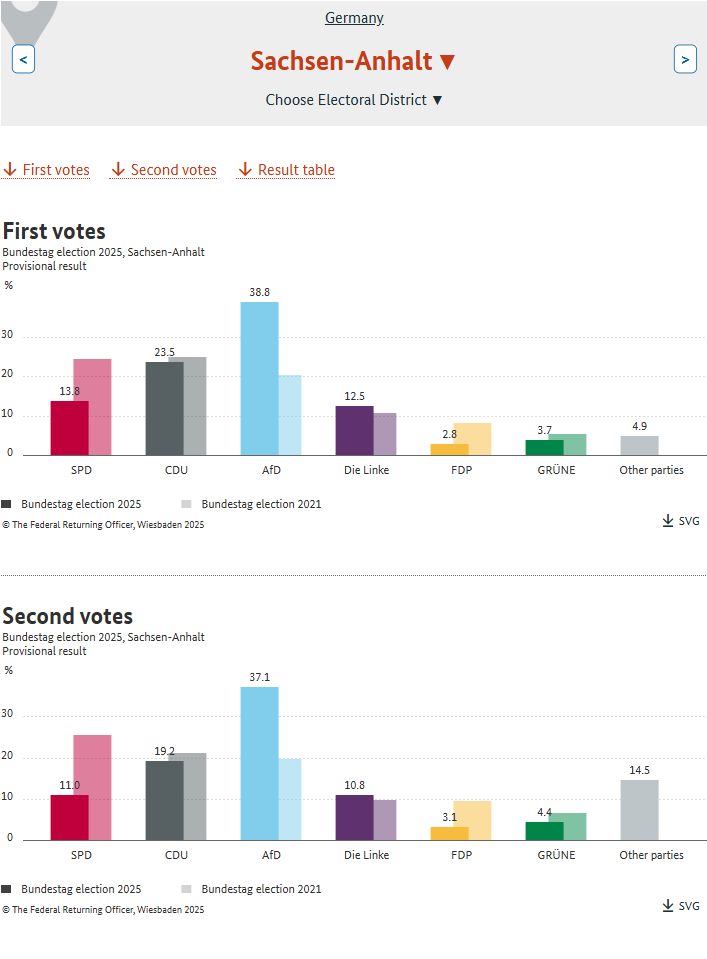
When we compare per-region ballots to those of the previous federal elections in 2021, we can notice something else:
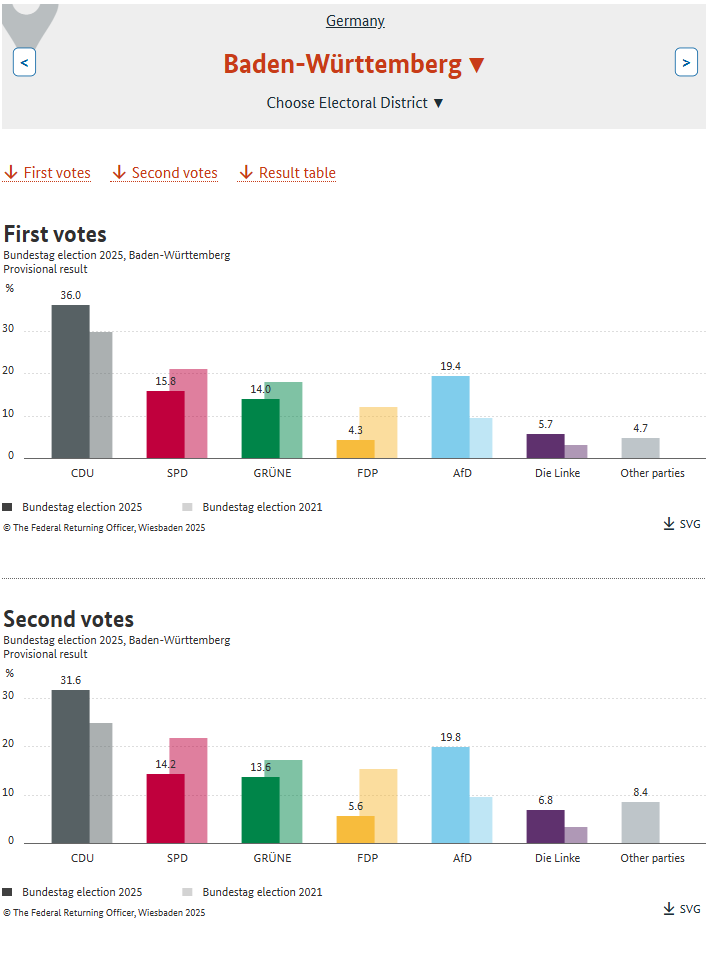
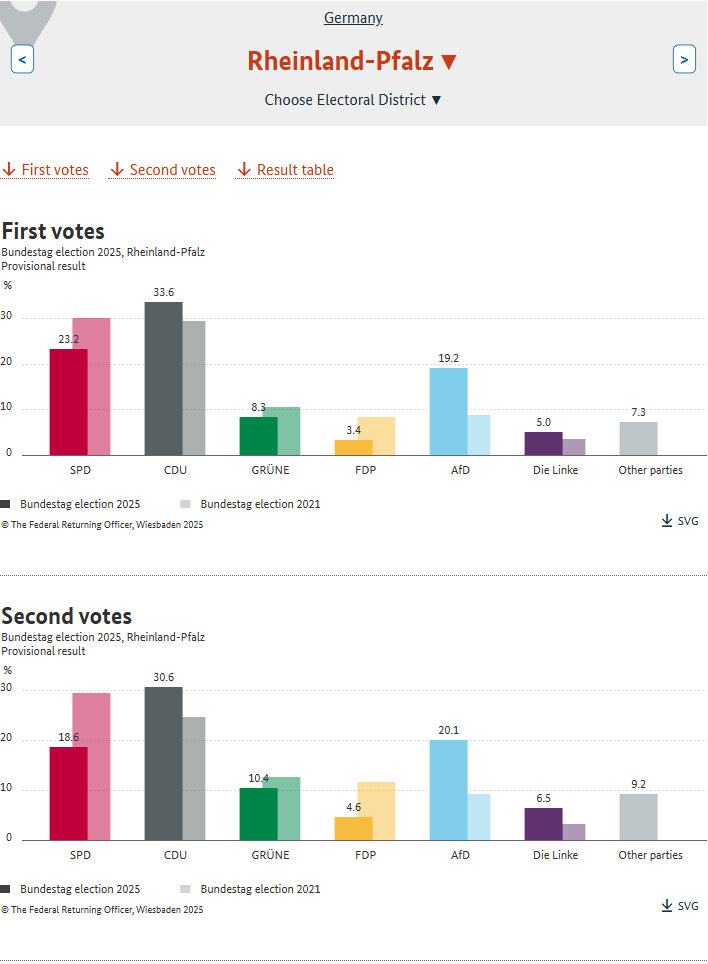
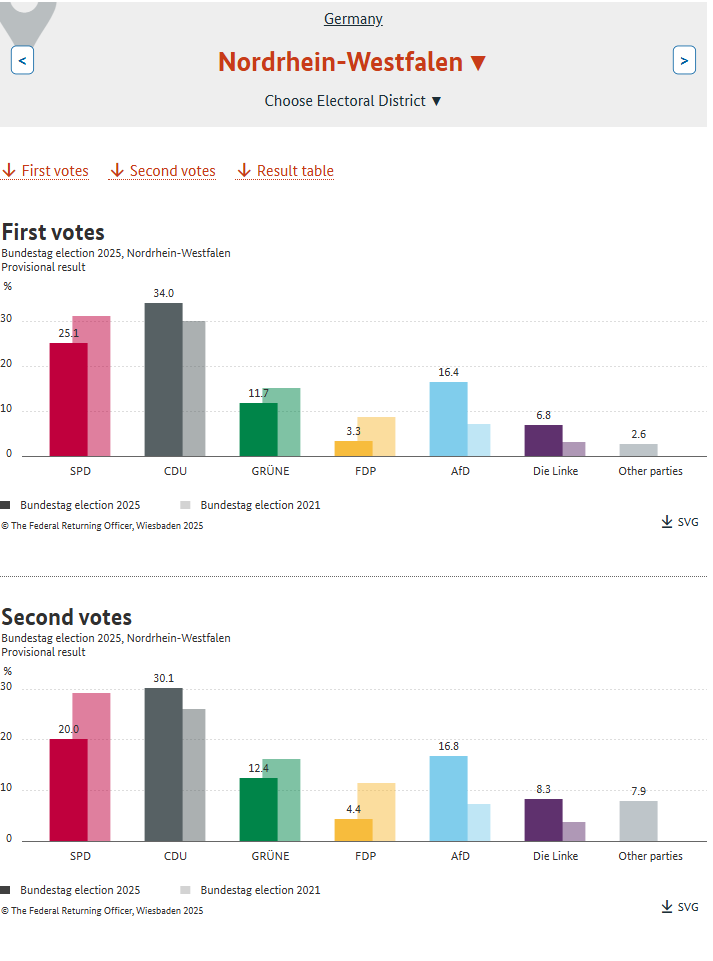
Federal states in the former FGR (West Germany):
Federal States in the former DDR (East Germany):
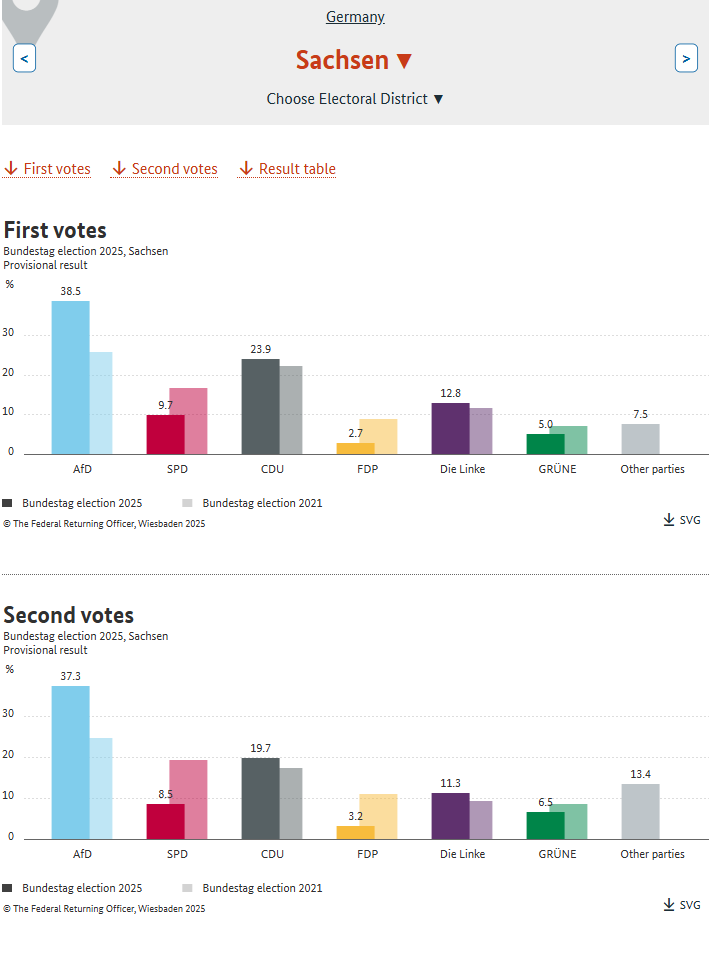
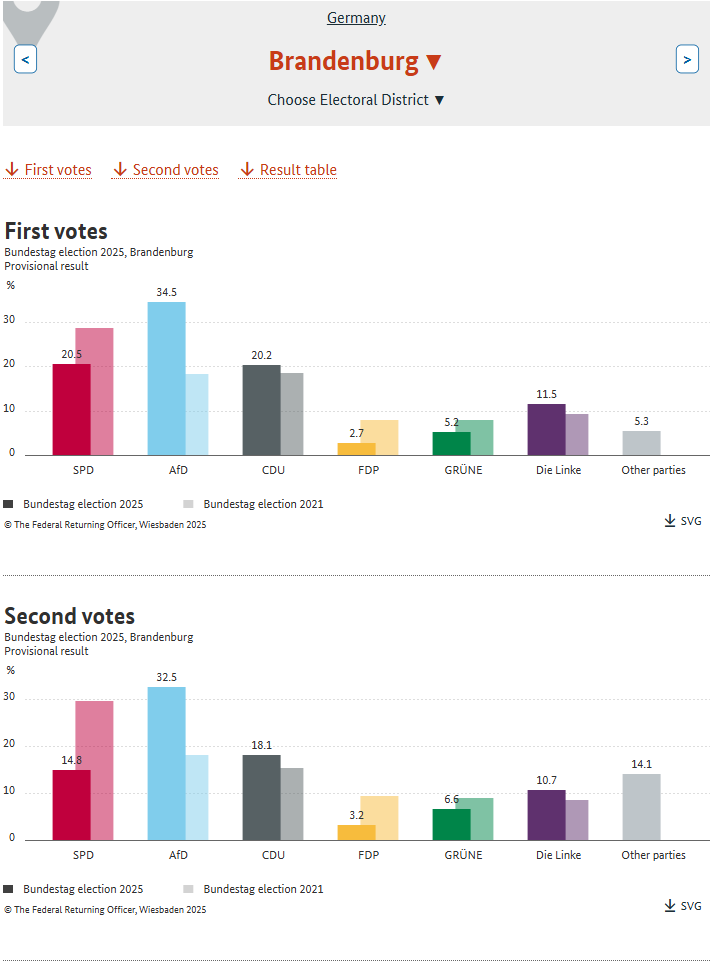
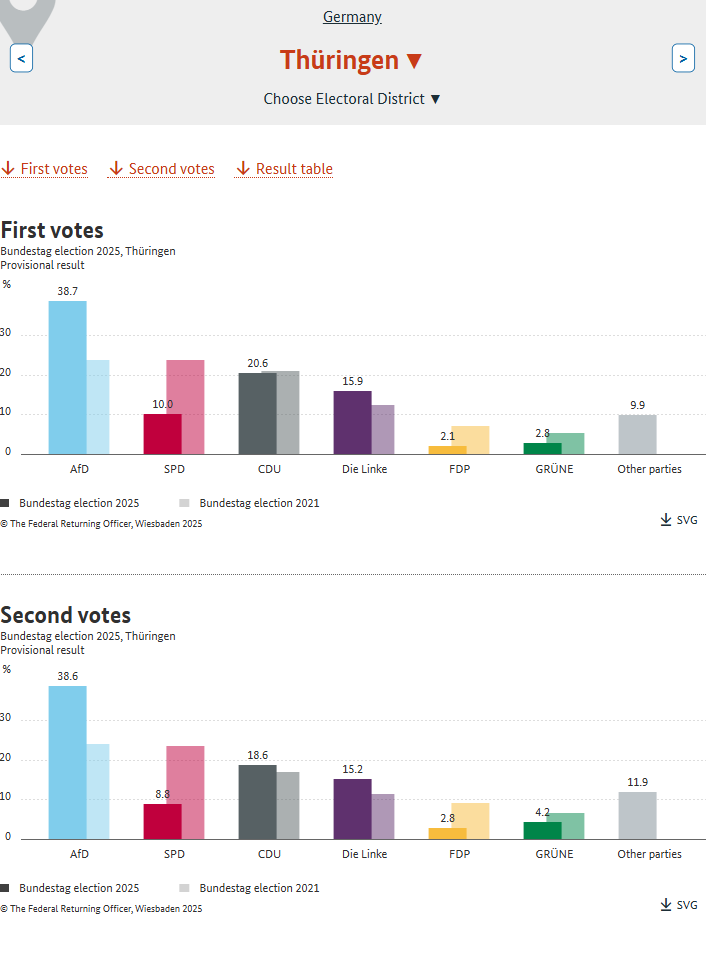
Berlin:
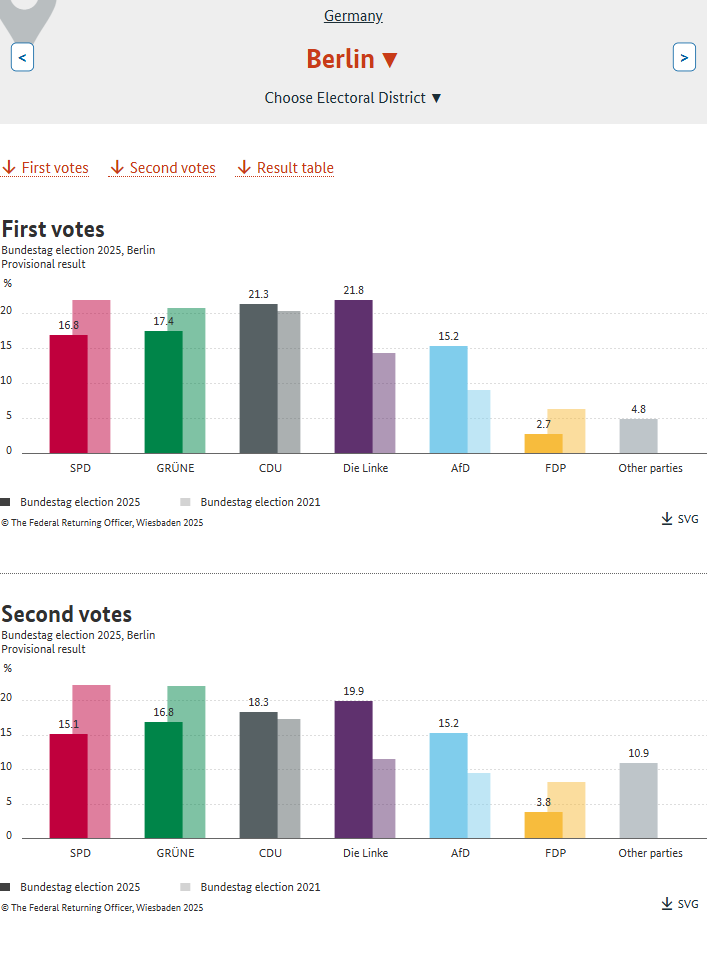
Look carefully, what do you notice? What was, in 2021, a fringe 4th party, mainly concentrated in the east, has doubled its voter base, both in the first and second vote, and has become the main opposition, certainly. But more importantly, notice how in the West German regions, the share of the 2025 vote lines up with its share of the 2021 vote in the East German regions (where its support has also doubled). It warrants repetition that AfD now has a support base in western Germany that equals its support base in eastern Germany in 2021. No longer is AfD contained within the former DDR. This is a huge breakthrough, and warrants attention, which brings us to the first narrative to address:
Narrative 1: The 2025 federal election was a crushing defeat for AfD
It empirically was not a defeat, and certainly not a “crushing” one. Any expectation of AfD outright winning the election, never mind forming government (which as stipulated above was improbable as it would need a majority outright, which has only happened once) is the product of attribution godlike election swaying powers to Elon Musk, and massively overstating Twitter’s impact on the German political consciousness. No one expected them to come anywhere close to winning (and even if they did, they would be unable to form a coalition).
It has, once more, improved its position from a fringe fourth party, to the second largest, doubled its support base, and has established itself as a federation-wide party rather than the former DDR’s regional party. This was a substantial victory for AfD, and ignoring it risks encountering a situation similar to that in France down the line. Some might recall that in France, Front Nationale’s rise was ignored mainly because whichever Left or Center party didn’t make it to the second round of voting would throw its support behind the one that did, if FN also made the second round, to stop the right from taking power. That inaction led to the scenario we saw in the most recent French elections, where FN had gotten so big that the centre and left had to resort to strategically consolidating their support by not running candidates against each other, as to avoid vote-splitting that would allow the right to take power.
While trends should certainly not be extrapolated from single data points, if AfD could continue to build on its recent election performance, Germany could find itself in a similar situation in a decade or two. Once we’re at the stage where vote consolidation is on the table, what’s left after that?
If the swell in AfD’s support is a protest vote, what social and political conditions are being protested? If the American right is correct and this represents a significant turn to the right, what is causing it? These issues need to be resolved before, not when or if Germany finds itself with a rising right that can no longer be contained.
Narrative 2: The German right is united, while the left is divided.
This is neither true nor relevant in the context of German elections. Germany has two center-right parties: the CDU/CSU and FDP, as well as the AfD, which represents the hard (or far, if you prefer) right. Die Linke and SPD represent the left, and the Greens represent the center/center-left.
Both left and right are divided, but it doesn’t matter due to the nature of the German electoral systems. Rule by coalition is the norm rather than the exception, and all parties except AfD are able to find sufficient common ground to form a coalition with.
Because this is a narrative I’ve mainly seen pushed by the American right, it offers some insight into the thinking of the American right, or rather, how far to the right it actually is relative to elsewhere, when CDU and FDP aren’t even considered to be on the right.
Narrative 3: CDU is forced to give in to AfD because it’s the second party.
This one is abject nonsense, a coalition has no restrictions other than that it must represent a majority of the Bundestag. Coalitions with either SPD, or with the Greens and Left Party meet this requirement. AfD’s inclusion in a ruling coalition is not necessary.